You crush pushes you to seek stronger flavors
Today’s Key Concept
When we have a crush on someone, we tend to buy products that have higher sensations: more flavors, spiciness, and other sensory stimuli.
We not only pick a movie, we pick a 4D movie.
A romantic crush puts consumers in a situation where they:
Have an unsatisfied goal “greater sensory stimulation” from another person
Cannot satisfy this goal from the person
In this case, the desire for greater sensory stimulation gets channeled through consumer experiences: products and services with higher stimuli.
What’s Surprising
It seems that when we cannot directly achieve a goal (getting together with the crush) we follow other indirect actions that may be connected to the goal.
In the paper Huang and colleagues (2019) give the example of MBA students who desire financial success. They cannot yet achieve this goal, and so they may purchase a luxury watch, as the only ‘success’ they can achieve right now.
In some cases, the overall goal is somehow influencing purchases that seem only slightly relevant to the goal.
If the goal is extremely important, many purchases may fall in line in a “hierarchy of goals” - some actions may be very indirectly connected to the overall goal, but still influencing purchase decisions.
In the paper, this hierarchy of goals influences consumers who cannot get together with their crush (the ultimate sensory stimulation) and may seek this intense sensation somewhere else, in the products and services they consume.
The overall goal is colouring the consumers’ purchases.
The desire to get together with the crush is found in everyday purchase decisions.
The Study in Brief
The first study in Huang and colleagues’ (2019) paper took 90 undergraduates, screened to be romantically single. They were set in a room, at a single cubicle. First they had to answer the question:
“Do you have a crush on somebody right now?”
41 did have a crush.
Then, all undergraduates had to pick between a 8 paid of products, with one having a strong sensory experience, and the other a mild one.
For example, they could pick a strong coffee, or a mild coffee.
The 41 undergraduates with a crush picked the stronger sensory option 41.1% of the time on average, and the 49 undergraduates with no crush picked it only 39.5% of the time on average across all choice options.
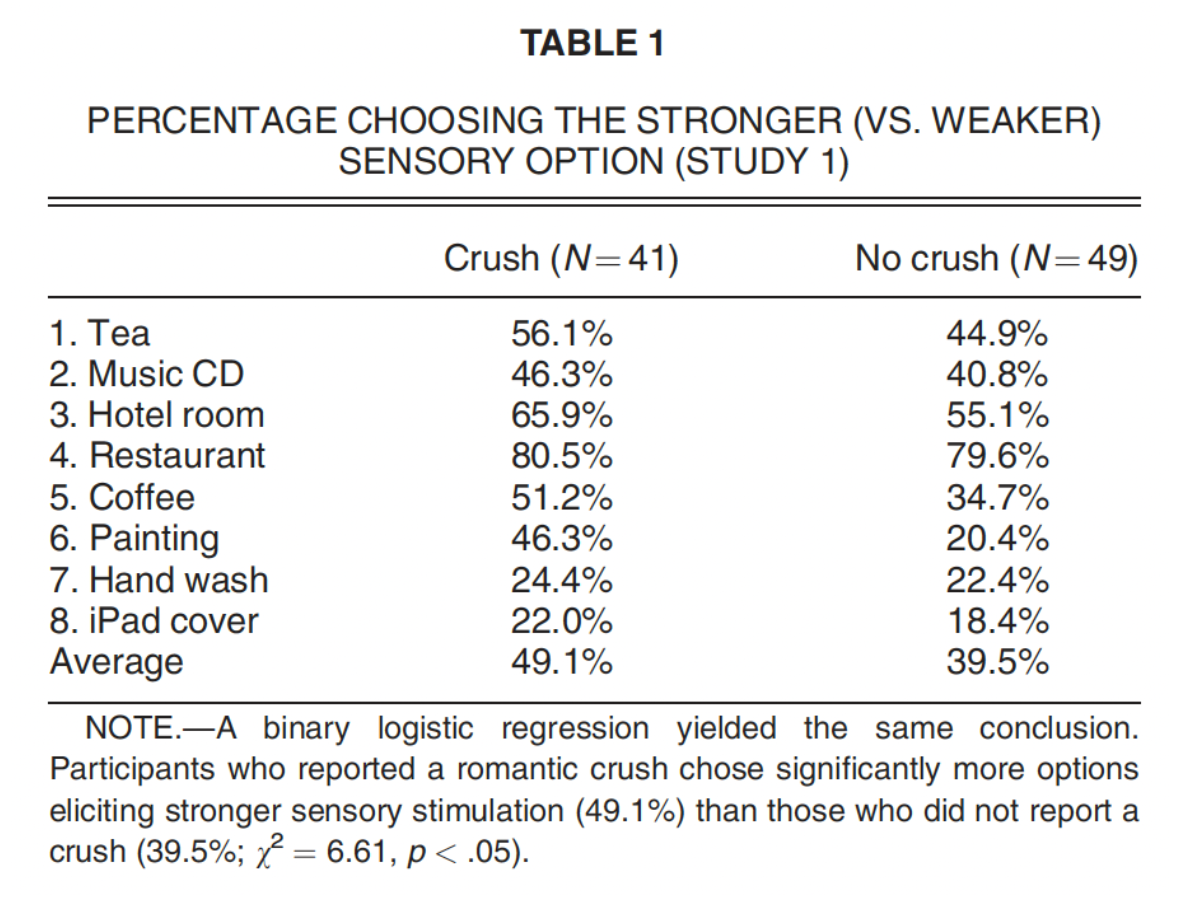
From this first study, the researchers observed a preference for stronger sensory option for people having a crush.
In the second study, 172 undergraduates were asked to recall either a previous crush, or a typical day.
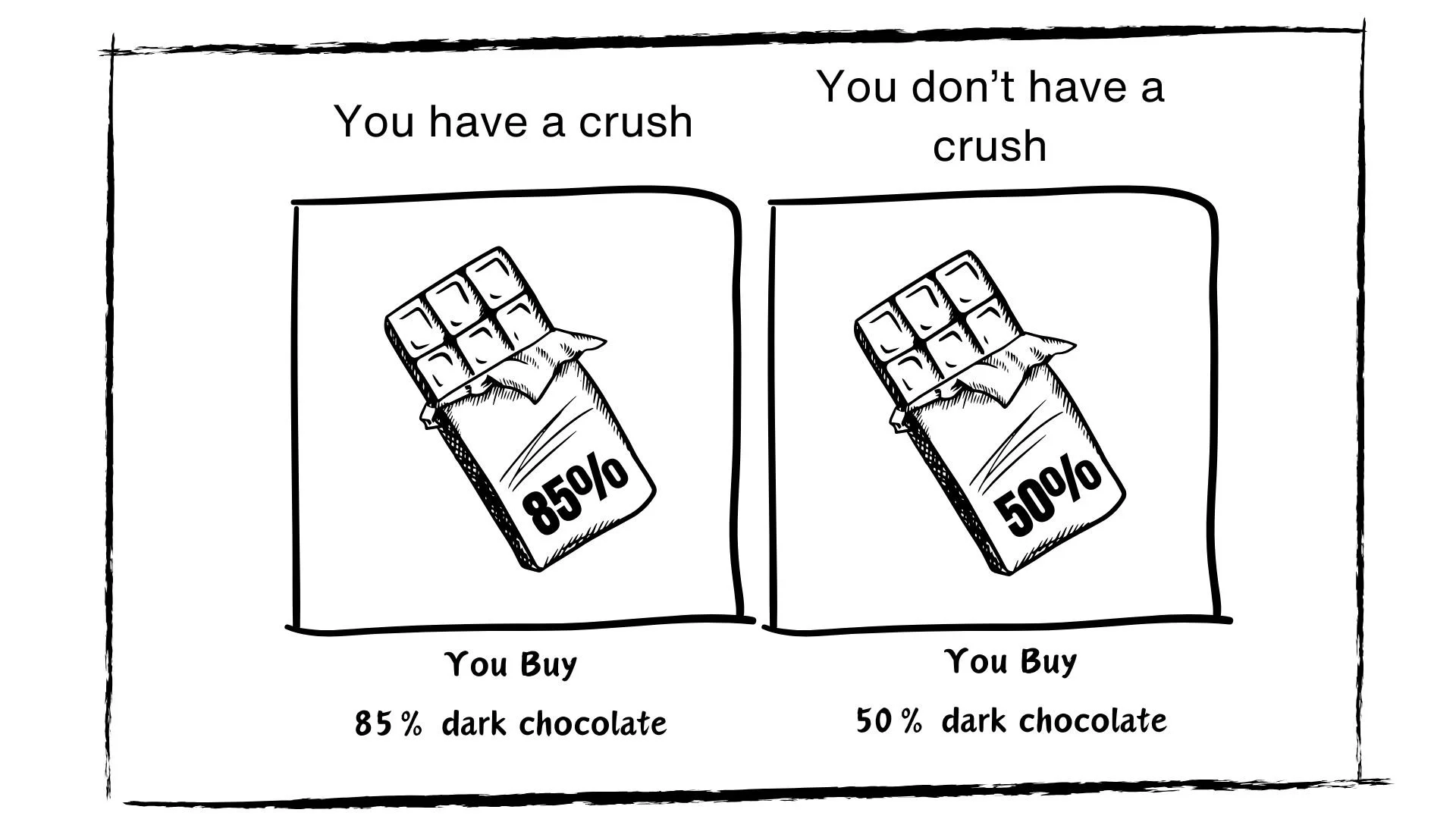
They then had to pick either between 85% extra dark chocolate, or only 50% dark chocolate.
The students who had to recall a crush picked the 85% dark chocolate option more, at a median of 54.8% against 38.4%.
The people thinking or having a crush were apparently seeking more powerful experiences. They picked the stronger sensory option.
According to the study, the people having a crush (an unsatisfied motivation, e.g. get together with the crush) end up seeking the thrill in everyday products and purchases.
In the authors’ own words:
"These consumers have a heightened motivation to achieve greater sensations from the desired person, but cannot act in a way that directly satisfies this motivation, leading them to be more likely to turn to products and services for the desired sensations.”
How Can You Use It?
The authors highlight that the paper may help brands adapt messaging and targeting to consumers on social media who are experiencing a crush. They also suggest strong stimuli product placements in programs that run romantic crush themes.
In a wider point, this paper reminds us that many different states may influence our purchases. It also highlights that some of these states may lead to unmet needs, and that we may try to achieve these needs through our purchases, even if this isn’t possible or only remotely connected.
In the case of this study, it suggests that an order for spicier food may somehow be connected to an unmet need coming from a crush.
Markets and consumers work in mysterious ways.
What’s the Source?
HUANG, XUN (IRENE), PING DONG, and MENG ZHANG. “Crush on You: Romantic Crushes Increase Consumers’ Preferences for Strong Sensory Stimuli.” Journal of Consumer Research 46, no. 1 (2019): 53–68. https://www.jstor.org/stable/27030267
