The Four Selves Consumer Framework
My book Why Did You Buy That Drink? started as a project to classify the different avenues of decision-making consumers go through when making everyday purchases.
The challenge, ambitious and sizeable, was to come up with a framework that could include all line items of one's annualised bank statement.
During my research, I have designed a simple framework that incorporate the science of consumer decision-making that I have come across. The framework is a simplified classification of consumer decision-making and has its trade-offs.
However, I believe it is useful to start investigating and mapping out the origin of our purchases.
1/ Introduction to the framework

[The Four Selves Framework, by Mehdi Bouhassoune]
The Four Selves are modes of decision-making consumers activate and go through.
The Internal Self is about decisions driven by internal triggers. Think of hunger, sugar level, gut microbiome.
The External Self is about decisions driven by external considerations. Think of status, culture, need for approval.
The Present Self is about decisions driven by the immediate environment. Think of ads, habits, attention.
The Future Self is about decisions driven by downstream consequences. Think of health concerns, retirement, diet.
As you can see in the diagram, they're spread over a spectrum from scene to story. The selves on the scene side are more directly impacted by their environment. The selves on the story side are more impacted by the stories and interpretations in their minds.
This is the basic framework, let's delve into it further.
2/ Examples
Let's bring the framework to life with some examples.

[Mehdi presenting the Four Selves Framework at DSM-Firmenich, the world's largest privately-owned fragrance and taste company]
Ahmed, a consumer, is walking down the street. He's experiencing some hunger, and is driven by his Internal Self to look for food. He looks at the street in front of him for options, as his Present Self is scanning the different restaurants. There's a fast food right ahead. Yet, at this stage, the Future Self and its goal of lowering cholesterol kicks in. Ahmed ends up walking a few more steps to a trendy salad restaurant.
A dating couple are out in the city. The External Self reminds the man that he better pick a restaurant signalling high-enough status. Looking at options, Future Self silently kicks in to remind the gentlemen of his bills and rent at the end of the month. Finally, the couple has an honest discussion and realise they both hate typical social expectations of dating. They decide to pick whatever options is next on their path, and the Present Self sits in a local restaurant.
A group of colleagues are going out after work. Dave always goes to this particular establishment, and is ready to act on autopilot and let his Present Self follow usual habits and patterns. However, his Future Self kicks in: he has been trying to cut alcohol as part of a marathon project in six months. He's considering a juice, yet his External Self reminds him of the need to choose a more refined drink in front of his boss. He picks a homemade kombucha.
As mentioned above, the Four Selves are modes consumers activate. This doesn't mean that they're absolutely exclusive. In fact, they're most often in a battle with one another, and remnants of a self can linger to impact the decision of another. The Four Selves are a way of mapping out this evolution and mode switching as decisions unfold.
Crucially, while all four selves can influence a decision, in the examples above, there's one clear self without which the decision would not have occurred. This is how the framework can be utilised, and how a particular self can be associated with a decision.
3/ The Science
Which of the selves is responsible for the purchase?

[Mehdi presenting the Four Selves Framework at Ogilvy, one of the largest advertising, marketing, and public relations agencies]
Definitely proving which self is responsible for a purchase is hard.
Luckily, we have a number of scientific fields to help us.
In the consumer decision-making framework, I have incorporated these different fields. As I highlight during my talks, they come with different tools to help us identify the origin of a purchase.

For example, the Internal Self is often accessed through fMRI studies and physiological markers (e.g. you tend to eat chocolate when your blood sugar is low).
The External Self is found in studies statistically noting the impact of others on purchases (e.g. you buy less flashy clothes when advised by a salesperson).
The Future Self is prevalent in economics and studies on future discounting (e.g. you pass on the cake now because you want to feel heathy later).
The Present Self is where attention studies and other cognitive functions are found (e.g. you buy the red product because you notice brighter colours).
There are scientific fields that more closely align with a particular self. For example in my book Why Did You Buy That Drink? I talk about studies from Jennifer Argo and Darren Dahl. The studies mostly look at the impact of others on our own purchases. They are, according to the framework, studies of the External Self. Would having another person in a store impact your purchases? Is there a difference between family shopping and single shopping?
Yet, the scientific fields and the selves do not always align.
This is precisely the value of the Four Selves Framework. It leverages these fields, while not being restricted by any of them. It is not a social psychology or an economics framework, it is a combination of all of the above.
4/ Using the Framework
There is a lot of value in understanding what led to a consumer's purchase.
I believe we need to understand individual decisions before attempting to scale them up.
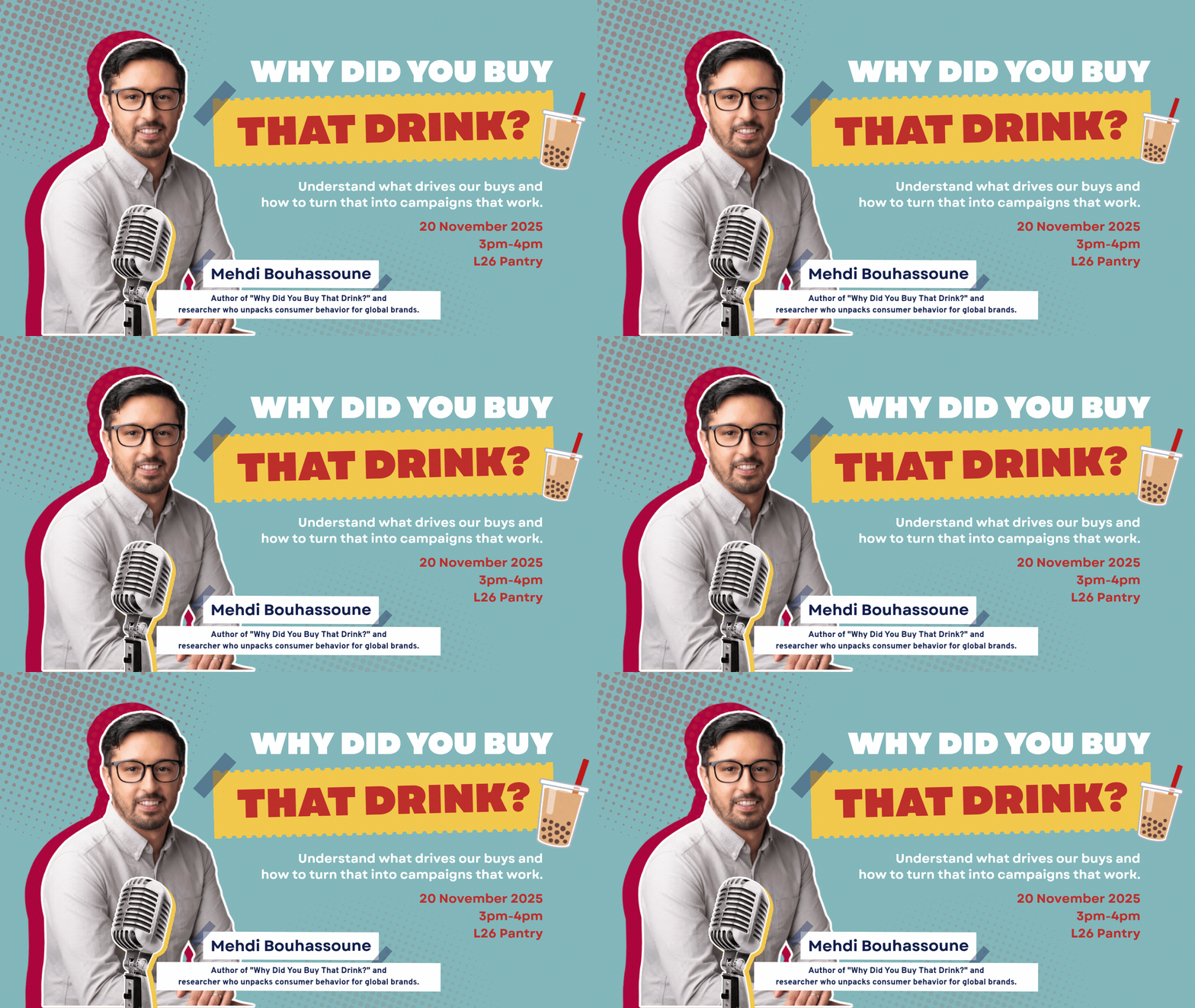
[Mehdi presenting the Four Selves Framework at Publicis, one of the 'Big Four' advertising companies in the world]
If a company decides to invest heavily in having their products available (believing the Present Self is what is driving purchases) but that consumers mainly purchase the product in the presence of others (External Self) or when primed about future health consequences (Future Self), there is a missed opportunity.
Understanding which self is most influential on specific purchase decisions allows company to focus on the most impactful strategies.
Give food to hungry consumers, give validation to status-seeking ones. Adapting to the self helps maximise advertising and other tools companies have to match and entice consumers to their products.
This is why I am developing a series of questions companies can use to ascribe a self to the purchases of their products. By asking these questions and understanding the patterns behind a purchase, a self can be assigned as most influential to one's purchase.
Once a self is reliably identified as influential, companies can lean into it.
If a healthy brand realise that consumers in Future Self mode will go out of their way to find their products, they can focus on priming consumers for this particular self.
For example, they can talk about the health impact of fast food, the need to stay fit for an athletic project, or the cost of health care.
The value in improving our understanding of decision-making is high. For agencies and brands, it is about winning more business, maximising impact, and retaining clients.
Conclusion
Brands are the aggregation of single purchase decisions.
These decisions are very difficult to assess.
The Four Selves framework provides a way of simplifying this decision-making investigation while consolidating different areas of science. It's also built on a scene-story axis, helping us differentiate between the impact of our environment versus our own interpretations of it.
It can help you:
Adapt your brand narrative
Expand your reach to a different self
Position yourself differently than your competition
Invest in impactful strategies
Measure what matters
If you wanted to learn more about the Four Selves framework or wanted to hear me break it down further live with your team, do reach out directly to me.
.
.
.
The Four Selves framework is the overall practitioner theory behind my book. However, my book is aimed at the general public as well as marketing professionals. In this regard, it does not focus on the Four Selves framework. If you wanted to learn more my trade book, you can search Why Did You Buy That Drink?: The Surprising Science Behind Everyday Purchases or visit https://www.mehdibouhassoune.com/whydidyoubuythatdrink
